1 Pray
You will be bringing the Word of God to young listeners. You need the guidance of the Holy Spirit, wisdom from God’s Word, and the ability to reach the hearts of the children.
2 Study
Look up the story in the Bible itself and think about the meaning, verse by verse. Look up other Bible passages that teach about the same things. If the story is repeated in another part of the Bible, such as another of the Gospels, be sure to compare both. Use a good teacher’s guide or other helps if they are available.
Helpful teachers’ notes for many Old and New Testament stories can be found at God’s Hand in Our Lives.
3 Plan
You will want to organize your thoughts so that your students receive the best message and remember what they have learned. After studying the story, ask and answer the following questions:
A. What is the outer aim?
The outer aim is the facts about what happened in the story. For example: “Jesus showed his power as the Son of God when he fed 5,000 people with 5 loaves and 2 fish.”
B. What is the inner aim?
The inner aim is the meaning of the story for each Christian. For example: “Because Jesus has the power to feed 5,000 people, he has the power to take care of all MY needs, especially my need for a SAVIOR from sin.”
C. What is the message of the Law?
The Law is what God expects from us and the punishment that comes from breaking his Law. The Law shows us that we are guilty of sin.
“All have sinned and fall short of the glory of God.” Romans 3:23
D. What is the message of the Gospel?
The Gospel is the good news about what God has given to us in Jesus. By grace he has given us full forgiveness of all our sins and the promise of eternal life. All this is only because of Jesus’ death in our place and his resurrection.
“and are justified by his grace as a gift, through the redemption that is in Christ Jesus.” Romans 3:24
E. What does this story teach about fruits of faith?
Because of God’s love to us in Christ, the Christian now wants to live a life that pleases God. What does the story tell us about the life we should now live as God’s children?
“I am the vine; you are the branches. Whoever abides in me and I in him, he it is that bears much fruit, for apart from me you can do nothing.” John 15:5
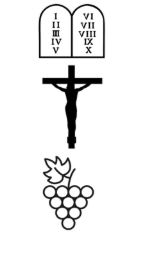
Gospel
Fruits of Faith
F. Keep Law and Gospel at the heart of the lesson
Be careful that your lesson focuses on Law and Gospel first, with the most emphasis on the Gospel. The biggest mistake that teachers make is when they only teach the children about rules and morals. For example: “God wants you to be good children. Here is a Bible story that shows you how to be a good child. God loves children who are obedient.”
Instead, show the children God’s Law—his commandments, our guilt, and the punishment for sin. This prepares a child’s heart to hear the Gospel—God’s free gift of forgiveness and life through faith in Jesus. Only the Gospel brings faith to a child’s heart. God’s great love because of Jesus will then provide the best reason for the children to show real fruits of faith in their lives.
4 Teach the Class
These are suggestions; not every class will follow them in exactly this order.
- Open with a prayer and a Christian song for children.
- Review the lesson from the previous week. Ask the students questions about what they learned. Have them recite the memory passages that you gave them, and say them aloud together.
- Tell a story as an introduction. Use a different Bible story or an imaginary story that explains the same lesson as your inner aim. Tell the children that they will learn the same lesson from today’s Bible story.
- Tell the Bible story to the children.
- Know the story well enough that you can tell it in a good way, including all the details as they are found in the Bible. Speaking to the students directly is much better than just reading the story. Look at each of the children, not just the ones who are paying attention.
- You want them to remember the facts about what happened—the outer aim.
- As you tell the story, ask the children questions about things you just said, making sure they know who was involved, what happened, and so forth.
- Have the students tell the story back to you. Repeat the beginning of the story, and then ask a student, “What happened next?” or “What did he say then?” Ask why questions: “Why do you think he did that?” or “Why did she say that?” During this review, teach the children the inner aim.
Another way to review is to have the students present the story as a play. One student might be Jesus and others the disciples. Help lead them through remembering the story that way. Ask the why questions as you go.
- Finish the lesson by asking the students about the facts of what happened—the outer aim. Then ask them about the meaning of the story—the inner aim. Then tell them what Christians now want to do because of this good lesson—the fruits of faith, or the way we ought to live as God’s children.
- Have the students complete a coloring page or craft if materials are available.
- Give the students one or more Bible passages to memorize for the next class. Read the passages out loud together and explain the meaning.
- End the Sunday School class with a Christian song and a prayer.